

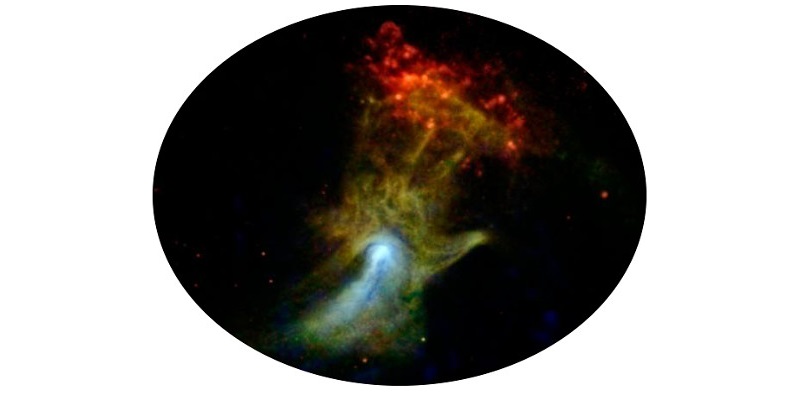
NASA spacecraft snaps X-ray photograph of “Hand of God.” Sure, okay, they say it’s just random chance that ejected material from an exploding star looks like a giant hand, but we know a hand when we see one. We just hope whoever lives in that reddish cloud has been living right.
View Comments (41)
Made me think of this album cover: http://www.nordicmission.net/users/nordic_mystore_no/images/nealmorsemomentum.jpg
If you don't have it... GET IT!
Well if it is the Hand of God, I hope it delivers a smack across the face of earth....
No, just DC and the UN.
Soon... just wait...
The Hubble Ultra Deep Field in 3D
http://www.youtube.com/watch?v=oAVjF_7ensg#t=43
Just a glimpse of eternity.
Ohmygod, you just ruined my day. If that video was really produced by scientists, we have a serious lack of brains in the sciences. No way was that done correctly. It looks like that stupid Star Trek video. Stars don't pass by your window as you move through the universe, nor do galaxies. I've had this discussion at so many parties and social gatherings... I seriously cannot believe astronomers could have produced this.
Here's what you would see if you ever managed to travel that fast through the universe (ignoring wavelength shifts that would change all the colors): at warp drive you would see... nothing change. Nothing change. Nothing change. Things are that far apart in space. Then, once in a great while, if you really did happen to pass one of those points of light in your window, what would happen is that suddenly one of those points of light would expand visually - explosively expand - and if you got close enough to actually see it appear to move it would at that point be HUGE, because let's remember, it is in fact a giant ball of fusion that dwarfs your measly spaceship.
YOU WOULD NOT PASS POINTS OF LIGHT. THOSE THINGS AREN'T GLOW-IN-THE-DARK STICKERS ON YOUR BEDROOM CEILING.
Stars shifting in background could be measured from the earth itself, as it orbits the Sun, back in the 19th century. This is where "parsec" comes from (paralax second). Stellar objects one parsec away will shift one arcsecond against background. No idea how old-timey science could measure such a small thing..
Depending on how fast you were going I could conceive of at least a few of the nearer stars perceptably shifting against background.
Of course relativistic effects of light falling on an FTL ship would distort all views. Wavelength shifts, as you mention, would push many visible objects out of human perception. Some hitherto invisible signals would register on human eyeball. Imagine the cosmic radio background suddenly becoming visible. Instrumentation could collect it all and render something incomprehensible, probably smeared lines of light, blur, and static/noise, maybe, instead of points.
Hope I can see it someday
No idea how old-timey science could measure such a small thing..
I don't think they measured it, just figured it out mathematically.
I believe it was Han Solo, on the Kessel Run..
Well now that I think about it, it was probably doable with the advent of photography in that century. I know there were European astronomers starting to plot actual distance to the nearest stars, where the parallax measurement was doable.
Yeah, any FTL effects are pure conjecture. And I agree there would be some movement of the stars, mostly imperceptible. What you wouldn't see is what you see in the video: all the stars moving without changing size as they pass to either side like a bunch of snowflakes around a car windshield at night. Drove me crazy every Star Trek episode... and I loved Star Trek.
Doesn't this go back to Einstein's theory of relativity and the question he once asked about wondering what the universe would like if one could ride on a beam of light?
Good thing that was before Star Trek or he never would have thought up the Theory of Relativity.
But if you were traveling faster than the speed of light, and you looked out the back window of the space craft, you couldn't see anything, right?
"...you couldn’t see anything, right?"
Your hi-beams. What? The corner, again!?
I love seeing the hi-beams.
Oh, wait. You're talking about a car's hi-beams? Never mind.
Oh lord, here we go. If you looked out the back window, (I think) you would see light arriving at exactly the speed of light in a vacuum. No matter which way you look you should see light arriving at the same speed. The only difference will be the color because the wavelengths will be different.
Wait, I forgot we're talking about a spacecraft with warp drive... I don't think Einstein allowed for faster-than-light travel. So who the hell knows what you would see out the back window? Maybe Timothy Leary knows.
Yeah the FTL/relativistic implications are pretty mind boggling. You are right, though, that if your ship was going .99c, the light falling on you from behind would still arrive at c relative. How does someone even come up with that observation?
It makes a little more sense when you realize why: your clock is slower at .99c. Or more accurately, your time is slower. There is no actual thing as a "ship going at .99c." There is only acceleration or no acceleration. If you and I pass each other at .99c relative but neither of us is accelerating, we're basically living the same life in the same conditions and so of course we see light arriving from every direction at the same speed. Wait, I just confused myself dammit.
so of course we see light arriving from every direction at the same speed
I'm not sure about that. Wouldn't the light you are approaching be coming at you faster than the light you are moving away from?
It doesn't seem constant. It is constant. The universe's absolute speed limit.
Are you sure it's light and not the limitations of the eye that keep it seeming constant?
It doesn't. That's one of Einstein's weirdest predictions. Like JP notes, spacetime starts doing crazy things to keep the speed of light constant to any observer.
I'm trying to avoid heading off into research wasteland of internets.. even if I understand it for a second, it'll fade
Nope. Mysterious, isn't it? Light changes speed depending on the medium through which is travels, but otherwise...
I just don't understand how he made that leap in his head. He pegged c as a constant, and then let spacetime warp around all frames of reference to maintain the peg. And he did it all before it was observable. I've tried to step through to see if I felt his Eureka!.. not even close
It was a mental exercise, meant to accomplish nothing other than to give me a headache. I never considered whether it was possible or not.
But then, if you were traveling toward each other, each going .99c, then when you pass each other, you would still be traveling the same speed, without increasing acceleration. So, it is possible if you think of it like that.
Once you postulate a FTL vehicle you have left Einstein's Theory of Relativity behind, so if you want to talk realistically you have to do what Alien did and postulate traveling close to the speed of light, not faster than the speed of light. And even then you have paradoxes - if I accelerate to Alien's .99c east and you accelerate to .99c west then we are moving away from each other faster than light. This is where the headaches start because the theory is adamant than nothing can travel faster than light - the force necessary for the acceleration would be infinite.
So... did that help?
Just to toss my lifelong musings into it, my belief is that if you were traveling faster than the speed of light, and looked back in the direction you came from, you couldn't even see your hand if you held it up in front of you.
The speed of light is constant, right? Therefore, by my uneducated calculations, light couldn't even escape in the direction of travel from an object traveling faster than light. I've been thinking about this since I was about twelve. I know, I'm weird.
@JP lol true. We should all quit our jobs and collect unemployment... ya know, for science and shit
He probably wasn't at busy as you and me. We would've reached the conclusion if we had more time on our hands. I'm sure of it.
I'm thankful he's not flipping us the bird.
I hope he throws a thunderbolt.
If it strikes in D.C.
That's cool. I love all these ... weird to say... G-d's body parts being photographed in space.
The Helix Nebula dubbed "The Eye of G-d" is impressive.
http://en.wikipedia.org/wiki/Helix_Nebula
You know the sci-fi novel (I think Poul Anderson), "The Mote In God's Eye"?
Nope. Is it good?
Yes it is, be prepared to read about 300 pages in one sitting.
My other comment, simply "Crazy Eddie!", vanished in the aether.
Anderson wrote a TON, but for this one, we must tip our hats to Niven & Pournelle
@Alien - of course, maybe the horse will learn to sing!
Lord I loved that book series!
Yikes, the eye looks a little angry. Maybe it's looking at San Francisco.
*chuckles*
Although let's be truthful the entire Planet is whack...