

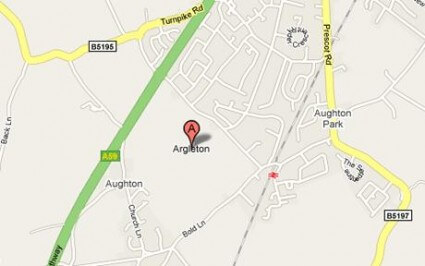
Google does many things that are beyond the grasp of mere mortals and this is one of them. Google Maps has placed a town called Argleton in the middle of the English countryside where none exists.
London’s Daily Telegraph tells the strange story and some of the problems it’s caused:
The town appears on Google Maps in the middle of fields close to the M58 motorway, just south of Ormskirk.
Its ‘presence’ means that online businesses that use data from the software have detected it and automatically treated it as a real town in the L39 postcode area.
An internet search for the town now brings up a series of home, job and dating listings for people and places “in Argleton,” as well as websites which help people find its nearest chiropractor and even plan jogging or hiking routes through it. The businesses, people and services listed are real, but are actually based elsewhere in the same postcode area.
Google and the company that supplies its mapping data are unable to explain the presence of the phantom town and are investigating.
Tantalisingly, “Argle” echoes the word “Google,” while the phantom town’s name is also an anagram of “Not Real G,” and “Not Large.”
Here’s the Google Maps page for Argleton. You can switch to satellite view to see the terrain (and no town).
What’s Google up to this time? Any ideas?
Source: Best of the Web Today
This post was last modified on November 3, 2009
View Comments (4)
I concur with Therese. Many years ago (before computers), I worked for a map maker. Each map had at least one fictitious road, or other item, which would, if copied by others, assure that proof of copyright violation existed.
I would guess that Google Maps has hundreds, if not thousands, of these within their maps.
This all may be, but I recently moved to a new city. I've since searched for a Bob Evans and a Lowe's using Google. I found no Bob Evans existed where I drove to (checked the GPS when I got there and it showed the nearest was 10 miles from where they stated).
I double-checked the Lowe's on the GPS after the BE incident and found Google was drastically wrong on that, too. They me going 2 miles east and 4 miles south when I needed to go 1 mile north and 3 miles west.
Nothing new here, Google maps shows the first four houses on my street and nothing else, the photo is from 1999! We moved here in January of 2001, the subdivision was completed in 2003. It's 2009, Google has had 6 effinn years to fix it!
I don't know if it's related, but years ago, I worked for a software company that sold code to Rand McNally and other map companies, and we knew that the companies, to prevent piracy of their products, usually placed a bogus town, road or creek on every map. If the bad data showed up on another company's maps, they knew they'd been pirated.
Could Google be plugging a little fake town in to prevent intellectual property theft? If so, they should fix it so their search engines are blind to it.