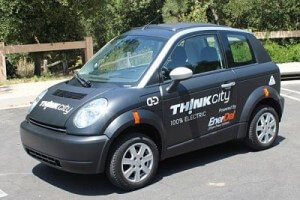
Think Global, the Norwegian car company that designed and manufactured the Think City electric car is swirling down the economic porcelain convenience.
Cue Queen singing “Another One Bites The Dust.” Despite the best of liberal intentions, another liberal dream is dead.
Think Global, the Norwegian car company that designed and manufactured the Think City electric car is swirling down the economic porcelain convenience.
It may be an electric car, but Think City's sales were hardly electrifying
This charming little 2-passenger car was supposed to sell for $28,000 but without generous subsidies available to American manufacturers, the price tag skyrocketed. Sales never amounted to a hill of beans. (As a side note, climbing a hill of beans would have drained the Think City’s battery and it would have needed to stop several hours for recharging.)
We’re sorry to report that Think Global has gone the way of most liberal pipedreams. It’s filed for bankruptcy and will be liquidated in an attempt to net a couple bucks for its creditors.
For god’s sake, man, isn’t there a Norwegian version of Uncle Sugar to make sure that billions of Norwegian tax dollars get wasted on wacky liberal Euroschemes?
An electric car owner would have to drive at least 129,000km before producing a net saving in CO2. Many electric cars will not travel that far in their lifetime.
Obviously, we exaggerate. Not about green cars not being green, but about red faces in the Obama administration. This bunch proved long ago that they are beyond being embarrassed by any of their actions.
But let’s get back to the green car myth with The Australian:
"It's for the environment" has joined "It's for the children" in the pantheon of plaintive liberal wails
Electric cars could produce higher emissions over their lifetimes than petrol equivalents because of the energy consumed in making their batteries, a study has found.
How is that possible? We’ve been told that electric cars would cure all our ills.
An electric car owner would have to drive at least 129,000km before producing a net saving in CO2. Many electric cars will not travel that far in their lifetime because they typically have a range of less than 145km on a single charge and are unsuitable for long trips. Even those driven 160,000km would save only about a tonne of CO2 over their lifetimes…
The study was commissioned by the Low Carbon Vehicle Partnership, which is jointly funded by the British government and the car industry. It found that a mid-size electric car would produce 23.1 tonnes of CO2 over its lifetime, compared with 24 tonnes for a similar petrol car. Emissions from manufacturing electric cars are at least 50 per cent higher because batteries are made from materials such as lithium, copper and refined silicon, which require much energy to be processed.
Electric cars. The vehicles we’ll all drive on the road to ruin.
No matter how hard the Obama administration tries to cram these lemons down our throats, America doesn’t want them. Not even if gas goes to $10 a gallon.
The headline on a recent Gallup poll cracked us up: “Electric Cars Not an Attractive Option to Many Americans.”
It might just as well have read “Americans Don’t Like Getting Poked In the Eyes With Sharp Sticks” or maybe “Americans Like Pounding Their Heads Against the Wall Because It Feels So Good When They Stop.”
The bottom line: No matter how hard the Obama administration tries to cram these lemons down our throats, America doesn’t want them. Not even if gas goes to $10 a gallon.
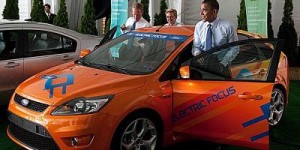
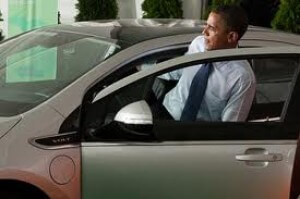
We're willing to bet the immense IHTM fortune that this is the only electric car Barack Obama will ever drive
Gallup has the details:
Americans are less likely to say they would buy an electric car than they are to say they would buy a more fuel-efficient one if gas prices rise to the $5-per-gallon range. Just 12% say at that price, they would be willing to buy such a car that they could drive only a limited number of miles at one time. Another 10% would make such a purchase if gas prices are in the $6- to $7.99-per-gallon range and another 9% if gas prices reach $8 to $10 per gallon. Still, 57% say they would not buy such an electric car no matter the price of gas.
High-income Americans are about twice as likely as those with low incomes to say they would purchase an electric car if gas prices rose to the $5 range. Otherwise, no matter whether respondents view higher prices as temporary or permanent, or the degree of financial hardship high gas prices are causing them, electric cars are equally unpopular as a response to high gas prices.
Who cares? Certainly not an administration committed to destroying the oil industry. Not an administration that believes in the religion of global warming. Not an administration that’s committed to “fundamentally changing America.”
And therein lies the rub. You can fundamentally change America all day long, but you can’t change market forces.
Perhaps this winter’s massive snow storms have convinced Al Gore to change his mind about global warming and word just hasn’t reach us yet.
Perhaps this winter’s massive snow storms have convinced Al Gore to change his mind about global warming and word just hasn’t reach us yet.
Telegraph UK has the story:
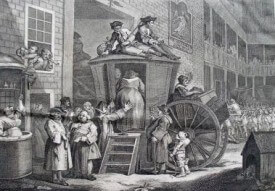
Progress: The 2011 electric car is half as fast as the 1830 stage coach
In its obsessive desire to promote the virtues of electric cars, the BBC proudly showed us last week how its reporter Brian Milligan was able to drive an electric Mini from London to Edinburgh in a mere four days — with nine stops of up to 10 hours to recharge the batteries (with electricity from fossil fuels).
What the BBC omitted to tell us was that in the 1830s, a stagecoach was able to make the same journey in half the time, with two days and nights of continuous driving. This did require 50 stops to change horses, but each of these took only two minutes, giving a total stopping time of just over an hour and a half.
Al Gore just called to say that he’s very concerned about the stage coach’s carbon hoofprint.
Clever devils, those socialists. They’ve devised a devious plan to create progressive driving rates, whereby the rich will be required to pay more per mile of driving than the poor.
Clever devils, those socialists. They’ve devised a devious plan to create progressive driving rates, whereby the rich will be required to pay more per mile of driving than the poor.
How, you may ask, is that possible? How can that be accomplished when gas pumps don’t know your income? Simple. By migrating gas-powered drivers to electric cars.
Fill 'er up, Comrade! We need to get to the revolution!
Consider, for example, the fact that Barack Obama and Joe the Plumber can now fill their gas tanks down at the corner Arco station and they’ll each pay the same price per gallon and the same taxes per gallon. In effect, a flat tax.
This obviously does not sit well with liberals. In their ideal world, everything would be taxed progressively.
And that’s where the electric car comes in.
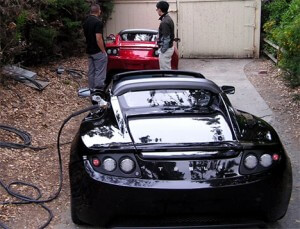
When you drive an electric car, you will no longer fill ‘er up down at the corner gas station and pay that same taxes, rich or poor. No. You’ll charge your electric car at home and be billed for the additional power by your electric utility.
Therein lies the socialist rub. Electric rates are not the same for every home and every homeowner. They are determined by the amount of electricity a home uses, usually defined in progressive (uh-oh, there’s that word again) tiers based on the number of kilowatt hours used. The more electricity you use, the higher tier you fall in, the more you pay, just like the progressive income tax.
The owner of a small home that uses very little electricity may get all his electricity at the lowest rate. He may even get it for free, because exemptions and subsidies allow some low-income people to avoid some or even all of their electric bill. However, the additional electricity required to power a medium-sized home is priced at a higher rate. And the additional electricity required to power a McMansion is priced at a still higher rate.
In most states, the highest usage tiers are priced significantly higher than the lower ones. For example, here’s what those progressive tiers look like on Pacific Gas & Electric bills in California:
Price per Killowatt Hour
Tier 1: $0.11877 for the first 98 KwH
Tier 2: $0.13502 for the next 29.4 KwH
Tier 3: $0.29062 for the next 68.6 KwH
Tier 4: $0.40029 for the next 52.3 KwH
(As you can see, socialism has come to our electric rates just as surely as it’s come to our tax code.)
Larger incomes mean larger homes. Larger homes mean more electricity. More electricity means higher tiers. Higher tiers means higher prices.
Finally, since electric and hybrid cars generally cost considerably more than their gasoline equivalents, it stands to reason that they are being purchased primarily by higher income earners who already live in larger homes and already pay higher electrical rates. If they weren’t already in the highest tier, the additional electricity required to power their new electric vehicles will surely put them there now.
Viola! Just like that, a person converting from a gasoline-powered car to an electric car goes from a flat tax (the same price for every gallon of gas) to a progressive tax (tiered pricing depending on usage).
Very clever, you socialist redistributors of income. Very clever, indeed.
First the government buys General Motors. Then they require the company to build electric cars that the public doesn’t want and won’t buy. So how can the government paper over this fiscal fiasco? By purchasing the cars from itself, of course.
First the government buys General Motors. Then they require the company to build electric cars that the public doesn’t want and won’t buy. So how can the government paper over this fiscal fiasco? By purchasing the cars from itself, of course.
We all know who's in the driver's seat for this fiscal fiasco
In the words of Aretha Franklin, who’s zoomin’ who?
Fox News has the details of the government-created demand for government-created products:
President Barack Obama’s administration has bought almost a fourth of the Ford Motor Co. and General Motors Co. hybrid vehicles sold since he took office, accelerating federal purchases as consumer demand wanes.
The U.S. General Services Administration, which runs the government fleet, bought at least 14,584 hybrid vehicles in the past two fiscal years, or about 10 percent of 145,473 vehicles the agency purchased in that period, according to sales data obtained by Bloomberg under a Freedom of Information Act request. In fiscal 2008, hybrids accounted for less than 1 percent of government purchases, the data showed.
The government is boosting investment in a technology that has failed to win broad acceptance after more than a decade in the marketplace. Consumer sales of hybrids are headed for their third consecutive yearly decline. Government agencies and businesses have said they also will purchase all-electric models being introduced by automakers including GM.
“At some point, the reality is that for this technology to be accepted, it needs to be done without a government crutch,” said Jeff Schuster, director of forecasting at J.D. Power & Associates in Troy, Michigan. “But without a huge gas-price increase or further government demand, the natural demand just isn’t to be there.”
To complete the story, it should be pointed out that Government Motors does have one other big customer in addition to itself.
General Electric, which makes the recharging stations for electric cars and who also received a big pile of stimulus money, has announced that it will buy a fleet of electric cars.
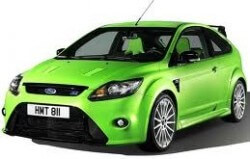
Ford anticipates owners of an electric version of its Focus hatchback may have to recharge it up to a whopping 1500 times a year — or up to four times a day
A little advice: If you buy yourself an electric Ford Focus, buy one of those new smart phones, too. Then immediately download the solitaire app, because you’re going to have plenty of time to play the game while your car’s battery is recharging.
The Ford Focus. Fill' er up, up to four times every single day of your miserable electric existence
The Sydney Morning Herald has Ford’s shocking news:
The car maker released details of the car this week that shows it anticipates owners of an electric version of its Focus hatchback may have to recharge it up to a whopping 1500 times a year — or up to four times a day.
The car may need so many recharges that the car maker says it has developed a special ergonomic plug so US customers can use a standard household power point to recharge their car, rather than using a special wall-mounted unit that cuts the amount of time needed to fully charge.
However, the system using the normal powerpoint can take up to 12 hours to fully recharge the Focus, meaning many owners will need to plug the car in several times a day to ensure they have enough reserves of electricity in the car’s batteries to fit in a full day of driving, potentially putting a strain on relationships with friends and employers as they borrow power to keep moving…
Ford says it expects electric car owners to need to plug in at up to 30 times the frequency that petrol-engined Focus owners will need to visit the petrol station.
‘‘Between plugging in and unplugging at home, work or other places, Focus Electric owners are likely to recharge their vehicles two to four times each day (nearly 1500 times a year) compared to once a week for gassing up (52 times a year),’’ the car maker says.
Articles like this usually bring out the eco-wackos who say we’re just making stuff up. But in this case, they’ll have to accuse Ford of making stuff up.
Chrysler has disbanded a team of engineers dedicated to rushing a range of electric vehicles to showrooms and dropped ambitious sales targets for battery-powered cars set as it was sliding toward bankruptcy and seeking government aid.
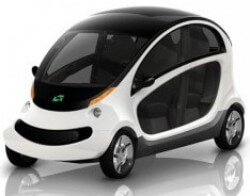
The Chrysler Peapod has come to the end of the road
Chrysler, part of the Obama Motors cabal, says its electric cars are dead. Not the batteries, the whole damn program. A huge pile of your tax dollars were at its bedside when it died.
Fox News reports Detroit’s latest tale of woe:
Chrysler has disbanded a team of engineers dedicated to rushing a range of electric vehicles to showrooms and dropped ambitious sales targets for battery-powered cars set as it was sliding toward bankruptcy and seeking government aid.
The move by Fiat SpA marks a major reversal for Chrysler, which had used its electric car program as part of the case for a $12.5 billion federal aid package.
As late as August, Chrysler took $70 million in grants from the U.S. Department of Energy to develop a test fleet of 220 hybrid pickup trucks and minivans, vehicles now scrapped in the sweeping turnaround plan for Chrysler announced this week by Fiat CEO Sergio Marchionne.
So Chrysler used the electric car scam to get a $12.5 billion bailout and then took another $70 million in grants and now they’re closing down the program less than 90 days later?
Bait and switch from a car dealer. Who ever would have expected that?
Whoever designed this program must have had too many brewskis at the 19th hole. It’s like Cash-for-Clunkers on steroids.
Did anyone notice the moment when economic stimulus ended and economic madness began?
Whoever designed this program must have had too many brewskis at the 19th hole. It’s like Cash-for-Clunkers on steroids.
Let’s just let the Wall Street Journal report this one while we take a few practice swings:
The federal (tax) credit provides from $4,200 to $5,500 for the purchase of an electric vehicle, and when it is combined with similar incentive plans in many states the tax credits can pay for nearly the entire cost of a golf cart. Even in states that don’t have their own tax rebate plans, the federal credit is generous enough to pay for half or even two-thirds of the average sticker price of a cart, which is typically in the range of $8,000 to $10,000. “The purchase of some models could be absolutely free,” Roger Gaddis of Ada Electric Cars in Oklahoma said earlier this year. “Is that about the coolest thing you’ve ever heard?”
The golf-cart boom has followed an IRS ruling that golf carts qualify for the electric-car credit as long as they are also road worthy. These qualifying golf carts are essentially the same as normal golf carts save for adding some safety features, such as side and rearview mirrors and three-point seat belts. They typically can go 15 to 25 miles per hour.
In South Carolina, sales of these carts have been soaring as dealerships alert customers to Uncle Sam’s giveaway. “The Golf Cart Man” in the Villages of Lady Lake, Florida is running a banner online ad that declares: “GET A FREE GOLF CART. Or make $2,000 doing absolutely nothing!”
Golf Cart Man is referring to his offer in which you can buy the cart for $8,000, get a $5,300 tax credit off your 2009 income tax, lease it back for $100 a month for 27 months, at which point Golf Cart Man will buy back the cart for $2,000. “This means you own a free Golf Cart or made $2,000 cash doing absolutely nothing!!!” You can’t blame a guy for exploiting loopholes that Congress offers.
This is obviously the Obama administration’s attempt to reach across the aisle to the rich country club Republicans.
Pardon us, but this story makes us want to go whack a few balls.