Which CBS executive hired Scottish comedian Craig Ferguson to host the Late, Late Show? Whoever it was deserves a raise, because it was an inspired choice.
Which CBS executive hired Scottish comedian Craig Ferguson to host the Late, Late Show? Whoever it was deserves a raise, because it was an inspired choice.
MSNBC’s Richard Wolffe was Ferguson’s guest on Wednesday night and tried to explain why he was against any extension of the Bush tax cuts. The following conversation ensued:
Ferguson: You’re a Democrat, aren’t you?
(Audience laughter)
Wolffe: I am a journalist.
Ferguson: A journalist?
(Audience laughter)
Ferguson: Much the same thing, isn’t it?
(Audience laughter)
Not only was Ferguson’s delivery and timing absolutely perfect, but so was Wolffe’s muted acceptance of the truth. He sat there in stunned silence with a silly grin on his face. Right next to the egg on his face.
Wave goodbye to another pile of your tax dollars and a few more of your freedoms. An adviser to the FCC wants to create a “public media” that can “filter” the news and be used as a “megaphone” by a vast network of government-funded journalists.
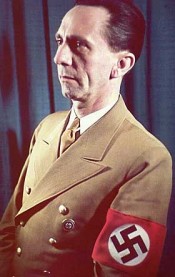
Josef Goebbels also thought the public media should be used as a filter and a megaphone
Wave goodbye to another pile of your tax dollars and a few more of your freedoms. An adviser to the FCC wants to create a “public media” that can “filter” the news and be used as a “megaphone” by a vast network of government-funded journalists.
Sounds like a great idea. What could go wrong?
Ellen Goodman, a Rutgers University law professor and distinguished visiting scholar with the FCC’s Future of Media Project, has a frightening plan to reshape the federal government’s communications policy…
“Information gaps are especially keen in the areas of investigative journalism, effective teaching materials, and content directed to underserved, minority, and poor populations…” according to Goodman and co-author Anne Chen.
“We have identified three core functions of digital public media, based on the directives of the Public Broadcasting Act and research on best practices in the field,” she says. “These functions are (1) to create content – particularly narratives in the form of journalism, long-form documentaries, oral histories, and cultural exploration – that markets will not and that is important to individual and social flourishing; (2) to curate content, serving as both a filter to reduce information overload and a megaphone to give voice to the unheard; and (3) to connect individuals to information and to each other in service of important public purposes.”
Of course, this is all necessary Goodman says, because while information is abundant, “wisdom and knowledge remain hard won.”
Absolutely. Certainly. For sure. And as we know, the government is the ultimate source of all wisdom.
Don’t know about you, but we really don’t want the government determining what gets filtered and who gets the megaphone. Especially this government.
The newspaper business may be dying, but journalists’ careers are being reincarnated by the Obama administration.
The latest is the Chicago Tribune’s Jill Zuckman. She’s hooking up with the administration as Director of Public Affairs at the Department of Transportation. Peter Gosselin, one of her coworkers at the Trib, recently hired on as chief speech writer for Treasury Secretary Timothy Geithner. Time Magazine’s Jay Carney is now Joe Biden’s communications director. CNN’s Dr. Sanjay Gupta is rumored to be in the running for Surgeon General.
Many conservatives fear this intentional blurring of the lines between impartial journalism and partisan politics.
(Hey, who picked up the mail today? Did anyone notice if our job offer came in yet?)