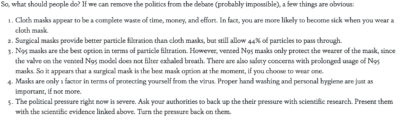
Masks are currently the hot button coronavirus topic. Should people be forced to wear them? Who should wear them? Do they offer protection? How much protection? The fact of the matter is, no American wants to die from anything–let alone coronavirus. If you give an American the honest truth about the risks of the disease and the effectiveness of the tools they can use to help themselves, they’ll rise to the occasion to do what makes sense.
That’s why it’s been surprising to many that our medical and scientific leaders have been so unclear about the mask issue. These leaders have made it almost impossible for anyone to know how to protect themselves.
A political-science journal that published an oft-cited study claiming conservatives were more likely to show traits associated with “psychoticism” now says it got it wrong. Very wrong.
The American Journal of Political Science published a correction this year saying that the 2012 paper has “an error” — and that liberal political beliefs, not conservative ones, are actually linked to psychoticism.
Panel: Finding climate fingerprints in wild weather is valid. Climate science, as you can see, is really progressing. Instead of scientific proof or doctoring data, all that is now required to prove a weather event is evidence of global warming is a wild-assed guess. We know this is true because a panel prognosticated it. OK we’re off to see our local witch doctor for the weather report.
Researchers at Cornell have designed, built and demonstrated the first “cloak” that hides events in time.
Science invents a cloak that can shield users from time?
Something tells us this story would have been good for that TV show “Ripley’s Believe it or Not!”. And not the lame remake with that former Superman actor. The cool one with Jack Palance.
Talk about your wrinkles in time
Gizmodo revs this story up to 1.21 gigawatts for us:
Researchers at Cornell have designed, built and demonstrated the first “cloak” that hides events in time. The process relies on similar methods of distorting electromagnetic fields as invisibility cloaks, but it exploits a time-space duality in electromagnetic theory: diffraction and dispersion of light in space are mathematically equivalent. Scientists have used this theory to create a “time-lens [that] can, for example, magnify or compress in time”.
The time cloak takes two of those lenses and arranges them so that one compresses a beam of light while the other decompresses it. That leaves the beam seemingly unchanged, but the diffraction and dispersion actually “cloak” small events in the beam’s timeline. Right now, the cloak can only last for 120 nanoseconds, and the theoretical max for the current design measures just microseconds. But the prospect of being able to exist outside of time, even for just a few microseconds, should be enough to make even the most jaded tech nerd giggle at the possibilities.
A device that can compress or magnify time. Were not sure what that means exactly. But if it speeds up our journey to 01/20/13 we’re all for it.