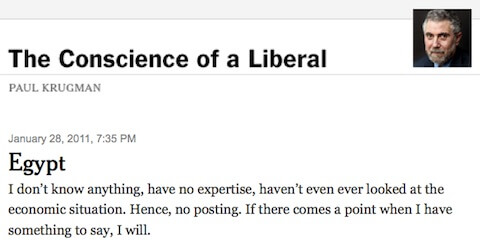
New York Times columnist Paul Krugman has built a career on his own unique combination of ignorance and arrogance. So we never thought we’d see the day that he admitted he didn’t know everything about everything.
In the words of the Editor’s dear, departed grandmother, “Why, I never …”
New York Times columnist Paul Krugman has built a career on his own unique combination of ignorance and arrogance. So we never thought we’d see the day that he admitted he didn’t know everything about everything. He’s been consistently wrong on the economy, the wars in Afghanistan and Iraq, foreign affairs, global warming, and based on the appearance of his beard, personal grooming. Yet, this vast ignorance has never once – until now – slowed the speed of his pompous pontifications.
If they ever give out a Nobel Prize for Ignorance, Krugman should win by acclamation.
Former Carter pollster Pat Caddell is a Democrat, but to us he’s always seemed to be one of the more rational ones. Now, perhaps, more than ever.
Former Carter pollster Pat Caddell is a Democrat, but to us he’s always seemed to be one of the more rational ones. Now, perhaps, more than ever.
The Daily Caller has news of Caddell’s anus animus:
On Fox News Channel’s Friday airing of “Red Eye,” host Greg Gutfeld wondered if the media were in denial over the notion it had little to do with the actions of Jared Loughner, the suspect in the recent Tucson, Ariz. shooting.
“Here’s an interesting point — as the truth comes out about this nutcase, doesn’t it seem like the media can’t believe that the killer doesn’t care about them?” Gutfeld asked. “It’s like they think they had an impact on him, when in fact all he cares about is UFOs.”
That led Caddell to launch into a rant about the media, specifically naming New York Times columnist and Nobel Prize-winning economist Paul Krugman and Newsweek and Daily Beast columnist Jonathan Alter.
“[T]he point is – you know, this thing started – I have to say, when I look at [Paul] Krugman and Jonathan Alter, with his advice and the president, ‘Don’t let this go to waste – let’s make it like Oklahoma City,’ and Krugman who is just a flat-out asshole, I’m sorry – these people, what they did…”
Caddell indicated their initial response should have been different.
“People are dead and the first thing you have to do is go to politics, I mean no wonder the country hates the media and hates the politicians,” he said.
Yes. We hate the media. You hate the media. And now Pat Caddell confesses that the country hates the media.
Nobel Prize-winning economist and New York Times liberal lunatic Paul Krugman has thrown FDR under the bus. He now admits that Roosevelt’s tax-and-spend socialism didn’t end the Great Depression, but World War II did.
Nobel Prize-winning economist and New York Times liberal lunatic Paul Krugman has thrown FDR under the bus. He now admits that Roosevelt’s tax-and-spend socialism didn’t end the Great Depression, but World War II did.
Paul Krugman wants you to take the $10,000 bill and go buy yourself a hamburger
We’re not sure he knows that’s what he did, but read his words from a recent column for yourself and see if that isn’t the obvious conclusion:
A naive view says that what we need is a return to virtue: everyone needs to save more, pay down debt, and restore healthy balance sheets.
The problem with this view is the fallacy of composition: when everyone tries to pay down debt at the same time, the result is a depressed economy and falling inflation, which cause the ratio of debt to income to rise if anything. That is, we’re living in a world in which the twin paradoxes of thrift and deleveraging hold, and hence in which individual virtue ends up being collective vice.
So what will happen? In the end, I’d argue, what must happen is an effective default on a significant part of debt, one way or another. The default could be implicit, via a period of moderate inflation that reduces the real burden of debt; that’s how World War II cured the depression. Or, if not, we could see a gradual, painful process of individual defaults and bankruptcies, which ends up reducing overall debt.
A little inflation. That’s all we need. And, of course, government economists are so adept at monetary policy that they will be able precisely control the amount of inflation they introduce into the economy.
Much like they’ve been able to precisely control the rest of the economy for the last two years.
You can always count on getting a good laugh from the comedy stylings of the New York Times’ Paul Krugman. In this interview with Jake Tapper, he sets the record straight and calls death panels by their proper name, which is … uhhhh … death panels.
You can always count on getting a good laugh from the comedy stylings of the New York Times’ Paul Krugman.
In this interview with Jake Tapper, he sets the record straight and calls death panels by their proper name, which is … uhhhh … death panels.
But that’s ok, because like every other provision of ObamaCare, they’ll save us money. Big money. Lots of money. Piles of money.
Krugman: Think about people on the right. They’re simultaneously screaming, they’re going to send all of the old people to death panels and it’s not going to save any money. That’s a contradictory point of view.
Tapper: Death panels would save money, theoretically.
Krugman: The advisory path has the ability to make more or less binding judgments on saying this particular expensive treatment actually doesn’t do any good medically and so we’re not going to pay for it. That is actually going to save quite a lot of money. We don’t know how much yet. The CBO gives it very little credit. But most of the health care economists I talk to think it’s going to be a really major cost saving.
This just in. Sarah Palin would like to thank Mr. Krugman for his inadvertent support.
It looks like Paul Krugman of the New York Times has an accuracy percentage that’s approaching baseball’s Mendoza line. So it must be particularly galling for Krugman when his lack of accuracy is exposed by his own newspaper.
Paul Krugman, Nobel Prize-winning columnist for the New York Times, is always leftist, but rarely right.
Is anyone keeping a scorecard? Because it looks like Paul Krugman of the New York Times has an accuracy percentage that’s approaching baseball’s Mendoza line.
So it must be particularly galling for Krugman when his lack of accuracy is exposed by his own newspaper:
“There’s a problem: conservative politicians, clinging to an out-of-date ideology–and, perhaps, betting (wrongly) that their constituents are relatively well positioned to ride out the storm–are standing in the way of action. No, I’m not talking about Bob Corker, the Senator from Nissan–I mean Tennessee–and his fellow Republicans. . . . I am, instead, talking about Angela Merkel, the German chancellor, and her economic officials, who have become the biggest obstacles to a much-needed European rescue plan.” – former Enron adviser Paul Krugman, New York Times, Dec. 15, 2008
“Why is Europe falling short? Poor leadership is part of the story. European banking officials, who completely missed the depth of the crisis, still seem weirdly complacent. And to hear anything in America comparable to the know-nothing diatribes of Germany’s finance minister you have to listen to, well, Republicans.” – Paul Krugman, New York Times, March 16, 2009
“The European economy bounced back with unexpected strength in the second quarter, buoying hopes that a worldwide recession was drawing to a close. The sharp improvement from the first quarter underscored just how far Europe and indeed the global economy had come since a harrowing free fall in late 2008. Underlying the strong reading were solid performances in France and Germany, each of whose economies grew slightly in the second quarter, according to government data released Thursday.” – News story, New York Times, Aug. 14, 2009
For those of you who aren’t baseball fans, here’s how Wikipedia defines the Mendoza Line:
“The Mendoza Line is an informal term used in baseball for the threshold of incompetent hitting. Even though Mario Mendoza’s lifetime batting average is .215, the Mendoza Line is said to occur at .200, and when a position player’s batting average falls below that level, the player is said to be below the Mendoza Line. It is often thought of as the offensive threshold below which a player’s presence in the Major Leagues cannot be justified despite his defensive abilities.”
We would call Krugman the Mario Mendoza of columnists, but we don’t wish to offend Mendoza.
Paul Krugman, the New York Times Nobel Prize-winning columnist and left wing lunatic, is wrong again. This time, about the Canadian socialized healthcare system.
Paul Krugman, the New York Times Nobel Prize-winning columnist and left wing lunatic, is wrong again. As usual.
During a healthcare debate at Rockefeller Center on September 16, Krugman decided to demonstrate the superiority of the Canadian healthcare system. He asked all the Canadians in the audience to raise their hands. Seven hands went up in the air.
That’s where Krugman should have stopped. Instead, he asked how many of our northern neighbors think they have a terrible healthcare system.
“Wholesalers expect the New York Times to increase its price from $1.50 to $2.00 for Monday to Saturday editions and from $5 to $6 on Sundays. A spokeswoman declined to comment.”
C’mon, man, these geniuses have Nobel Prize winning economist Paul Krugman on staff. Maybe they should ask him to explain the law of supply and demand someday at lunch.
A breakthrough for economist Paul Krugman? Lordy, Lordy, Lordy. It’s hand-wringing time in the Big Apple.
Treasury Secretary Tim Geithner’s latest bailout plan is causing a personal crisis of confidence for Paul Krugman, the New York Times’ Nobel-prize winning economist.
The plan is supposed to convince private investors to take up to $1 trillion in toxic assets off the hands of troubled banks.
“This is more than disappointing,” Krugman said in the Times. “In fact it fills me with a sense of despair.”
“It’s as if the president were determined to confirm the growing perception that he and his economic team are out of touch, that their economic vision is clouded by excessively close ties to Wall Street. And by the time Mr. Obama realizes that he needs to change course, his political capital may be gone.”
You know things are bad when we’re not pleased by anything that causes despair in Paul Krugman.
Don’t get too carried away with the headline. In reality, he doesn’t like either “stimulus” plan. He just likes Obama’s plan less than the Republican plan.
“Mr. Obama got nothing in return for his bipartisan outreach,” Paul Krugman concluded a recent article. “Not one Republican voted for the House version of the stimulus plan, which was, by the way, better focused than the original administration proposal.”
Krugman’s faint praise is like saying, “Your second ugliest sister is prettier than your ugliest sister.”
But he doesn’t really want to kiss either of them.
 In the words of the Editor’s dear, departed grandmother, “Why, I never …”