Guess which major political party hasn’t forgotten 9/11. Guess which major political party understands what the War on Terror is all about. And guess which major political party asks the question, “How does closing Guantanamo Bay make us safer?”
To the Chinese, this condom ad is pregnant with meaning. China’s official media protested a German condom ad that shows revolutionary leader Mao Zedong as a sperm cell. The campaign includes other ads featuring Adolf Hitler and Osama bin Laden.
The People’s Daily, the official newspaper of the Communist Party, devoted a full page to the controversy and demanded that the condom company apologize to China.
Grey Worldwide, one of the world’s largest ad agencies, created the safe sex ad for Doc Morris Pharmacies. They’ve reportedly sent a letter of apology to the Chinese consulate in Frankfurt.
Not all Chinese seem quite so angry, though. “I am a former worker who is now 70,” said one comment on the sina.com website. “I have thought about it a lot and I still cannot understand why these people defend Mao so strongly.”
He is survived by his wife, three children and seven grandchildren (all boys).
There's nothing more fun than watching the media devour themselves. This may be a case of the pot calling the kettle black, but the truth-challenged New York Times has attacked the Los Angeles Times for disguising advertisements as news stories.
One day after catching holy hell for disguising a front age ad for a new TV show as a news story, the LA Times did it again.
An ad in Sunday’s Calendar entertainment section ran alongside a four-page ad for a new movie called “The Soloist.” The four pages are designed to look like a news.
A Paramount Pictures spokesperson said the Times approached them with the idea. The complete advertising package included an online contest and promos that ran on KTLA, which is a Times sister company.
“You dress an ad up to look like editorial content precisely because you think it will make it more valuable,” said Geneva Overholser of the University of Southern California’s Annenberg School for Communication. “Fundamentally, that’s an act of deception.”
This is shocking. No, not the deception on the part of the Los Angeles Times. Everyone knows that. What’s shocking is that Overholser seems surprised by it.
Some time back, a great commercial showed up on the internet. It was supposedly created by a South African ad agency to promote Honda’s hybrid.
We say supposedly because the commercial was so simple and so powerful and so controversial that it just seems doubtful that any major advertiser would have the guts to run it. Honda denies any involvement. So does the ad agency that is credited with having created it.
The commercial became an internet sensation. It got millions of views. Then an Islamic activist group got its panties in a wad and demanded that the commercial be pulled off the internet. YouTube caved in and pulled the commercial. It’s now very difficult to find online.
We love the commercial. So we got our hands on a copy, did a little editing, removed any reference to Honda, and put a new ending on it.
We think new version is more powerful than the original. And more timely, too.
If you enjoy it, please tell everyone you know to see it at IHateTheMedia.com.
Readers of the L.A. Times know the paper sometimes slants the news and other times reports it very selectively, but now they’re guilty of completely fraudulent news.
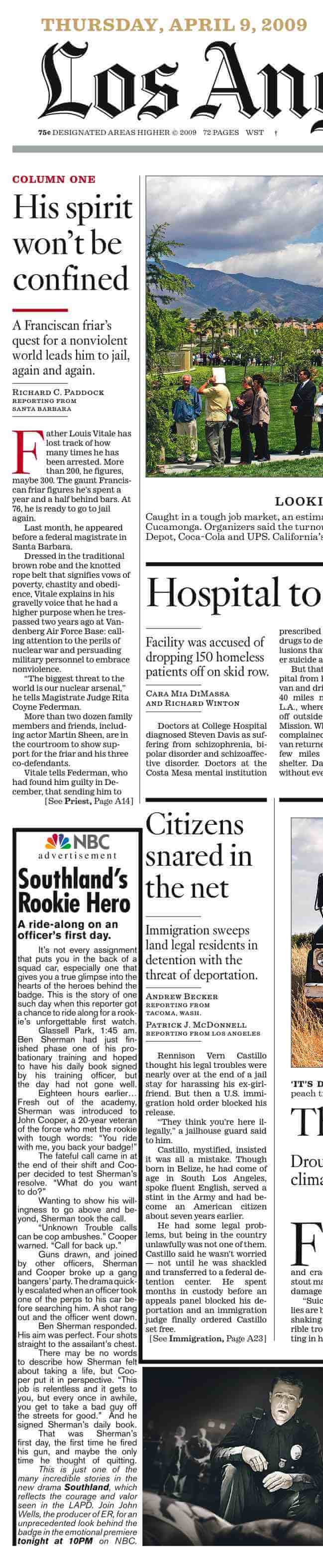
The front page of today’s Los Angeles Times features what appears to be a major feature story on a rookie LAPD cop named Ben Sherman. The story breathlessly reports his first day on the job.
Only one problem. Sherman doesn’t exist. He’s the lead character in a new NBC-TV program called “Southland” that premieres tonight. And the article isn’t really an article – it’s a paid advertisement.
The ad isn’t in the Times normal typeface and it’s subtly labeled as an “Advertisement.” But how many readers of the Times will notice the difference?
The Times has come under heavy criticism in the past for blurring the line between editorial and advertising. The decision to adorn the front page with a faux news story that can easily be confused for actual reportage will undoubtedly elicit howls of protest once again.
The Los Angeles Times. All the fiction that’s fit to print.
Please do not be shocked. We are about to use internet terminology we have never before used at IHateTheMedia.com:
WTF?
Sorry, but that’s the only possible reaction to the new commercial for Quizno’s new “Toasty Torpedo” subs. You know, the ones shaped like giant male genitalia. Watch the commercial. We’re pretty sure you’ll agree.
The commercial features a talking oven that seems to be the gay cousin of HAL, the computer from the movie “2001.” It starts with the gay oven talking to a Quizno’s worker about how much they “both enjoyed” something. We aren’t privy to what that something may have been, but the mere memory of it causes the worker to look down at his crotch.
Then the gay oven says “Put it in me, Scott,” referring to his tasty, toasty torpedo.
There’s just so much that’s wrong and tasteless about this commercial that you really wonder who it’s aimed at, who approved it, and why.
The whole commercial comes across like some strange homage to gay, sado-mechanical sex.
This is a great commercial. Actually, we don’t know if it’s a real commercial or just something Richter put together to express his opinion of pompous Prius drivers.
But first a story: We have a very good friend who lives in a ritzy neighborhood in Santa Monica, California, not far from Laurie David.
You remember Laurie David. Former wife of Seinfeld producer Larry David. Was touring the country with Sheryl Crow when the singer urged everyone to use just one square of toilet paper. That Laurie David.
We were walking down the street with our friend one day when we came upon another neighbor who was unloading groceries from her SUV. She was pissed.
“Laurie David just pulled up,” the neighbor said, “and yelled at me for driving an SUV instead of a Prius. What a bitch.”
Now that we’ve set the scene, watch the Andy Richter commercial. Be prepared to laugh.
In 2008, 30-second commercials went for as much as $1.8 million. This year, they’re going for as little as $1.4 million.
Once considered invulnerable to economic ups and downs, the Academy Awards has discovered that it can’t get away with jacking up the ad rates every year. Especially in a year when all five Best Film nominees have been ignored by movie-goers.
Here’s a tip for the Oscars’ nominating committee: Nominate movies people want to see and people will want to watch your awards ceremony.
If they can bring those rates down a little more – ok, a lot more – you could be seeing “IHateTheMedia.com Presents the 2009 Oscars.” If only we hadn’t blow our entire 2009 ad budget on expensive SuperBowl commercials Doritos.
We’re happy to report that General Motors isn’t spending $3,000,000 for a Super Bowl commercial this year. But what about other advertisers?
Is it wise to spend that much money on one commercial in this economic downturn? Surprisingly, many advertisers say, “Yes, it’s a bargain.”
Their rationale? The Super Bowl draws an immense audience and is, perhaps, the only programming on television that causes consumers to “lean forward” and watch the commercials.
No one will be leaning forward and watching the attached PETA commercial because it was rejected by the television network. Talk about your wardrobe malfunction.